
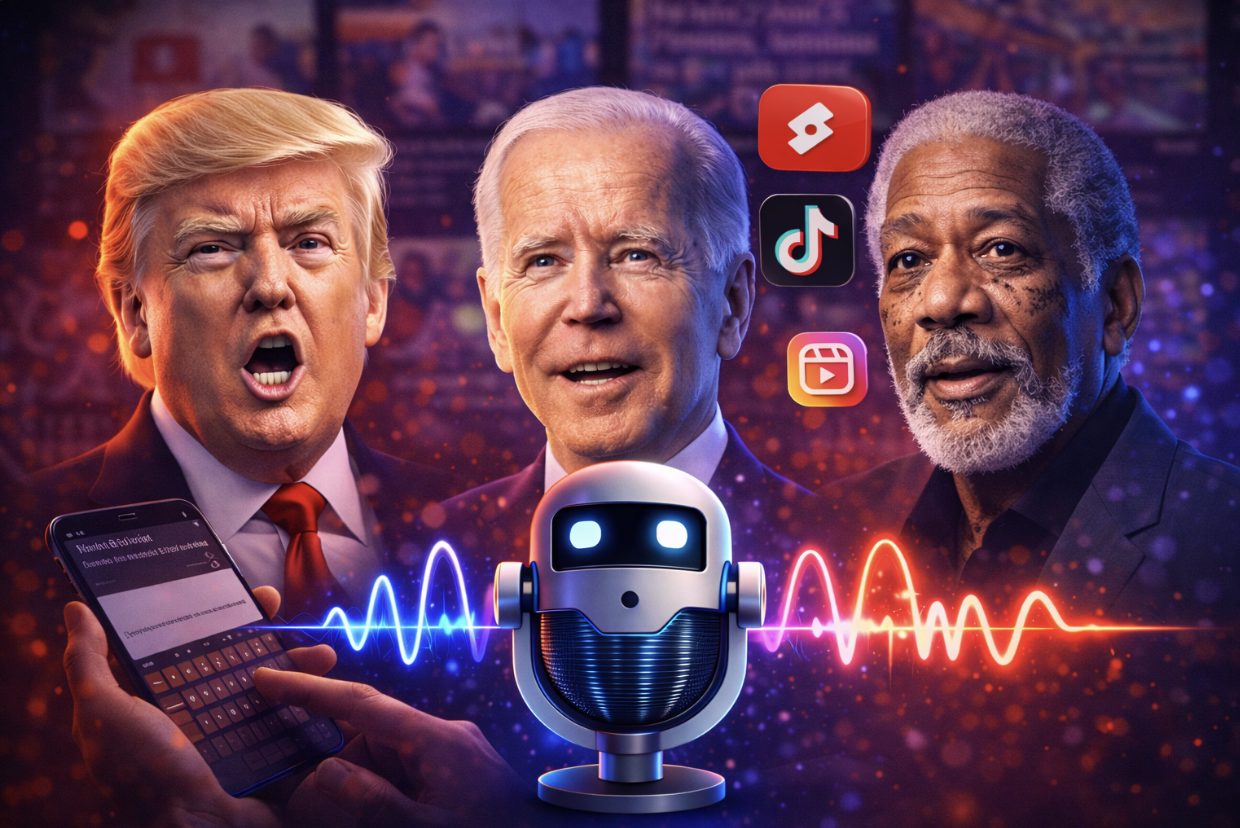
In 2025, AI celebrity voices are no longer a novelty, they’re a full-blown internet trend. From Trump and Obama parody clips to Morgan Freeman–style narration and viral meme voices, AI-generated celebrity voices have become one of the most recognizable elements of short-form content across TikTok, Instagram Reels, and YouTube Shorts.
What started as experimental tech has evolved into a repeatable content format used by creators, meme pages, and even brands. AI celebrity voices are now a tool for speed, recognizability, and virality, not just entertainment.
This article breaks down how the AI celebrity voice trend emerged, why it’s exploding in 2025, how creators are using it, and where it’s likely heading next.
What Are AI Celebrity Voices?
AI celebrity voices are character-style AI voices inspired by well-known public speaking patterns, tones, and rhythms. They are not exact clones or real recordings, but stylized voice models designed for parody, storytelling, and entertainment.
These voices are generated using AI text to speech, meaning creators simply type text and the AI produces spoken audio in a recognizable style. No microphones, no voice acting, and no editing required.
In practice, AI celebrity voices are used to:
- Narrate memes and short-form videos
- Create parody commentary
- Add instant personality to faceless content
- Turn simple scripts into engaging clips
The key value isn’t realism, it’s recognizability.
Why AI Celebrity Voices Are Exploding in 2025
The growth of AI celebrity voices isn’t random. It’s the result of several trends converging at once.
First, short-form platforms reward instant context. Viewers scroll fast, and creators have only a few seconds to hook attention. A familiar voice does that immediately. The moment a Trump-style or Obama-style voice starts speaking, viewers already understand the tone of the content.
Second, content creation has become more competitive. Creators are expected to post more frequently, often multiple times per day. Recording voiceovers manually doesn’t scale well. AI voices remove that bottleneck entirely.
Third, audiences are increasingly comfortable with AI-generated content. In 2025, viewers no longer ask “Is this AI?”, they ask “Is this entertaining?” As long as content is clearly parody or creative, AI voices are widely accepted.
Platforms Driving the Trend
AI celebrity voices are everywhere, but some platforms amplify the trend more than others.
TikTok is the primary driver. Meme culture, parody, and fast iteration make TikTok the perfect environment for AI voices. Many viral formats rely entirely on AI narration layered over simple visuals.
Instagram Reels closely follows, often mirroring TikTok trends with a slight delay. AI voices perform well here for storytelling, memes, and educational clips.
YouTube Shorts has rapidly adopted the trend as well. Shorts creators use AI celebrity voices to add narration to gameplay clips, memes, and slideshow-style videos.
Even long-form YouTube content uses AI celebrity voices for parody segments, storytelling, and comedic narration.
Why Celebrity Voices Work Better Than Generic AI Voices
Generic AI voices can sound clean and professional, but celebrity-style voices carry built-in personality. That personality does a lot of work for the creator.
A familiar voice sets expectations instantly. It tells viewers whether the content is serious, ironic, satirical, or absurd, without needing explanation.
Celebrity voices also create contrast. Calm, authoritative voices paired with chaotic visuals often perform extremely well. The humor comes from the mismatch, not the script alone.
Most importantly, celebrity voices reduce cognitive load. Viewers don’t need to learn a new narrator. They already recognize the style.
How Creators Are Using AI Celebrity Voices
In 2025, creators use AI celebrity voices in very deliberate ways.
Meme pages use them to react to trends, news, or absurd scenarios. The voice becomes the “character” of the page.
Faceless creators rely on celebrity voices to replace on-camera presence. Instead of showing their face, the voice becomes the identity.
Storytelling accounts use AI celebrity narration to make short stories feel dramatic or ironic, even with simple visuals.
Some creators run entire theme pages based on a single AI voice, building brand recognition around it.
What’s consistent across all of these use cases is speed. Scripts are short, generation is instant, and iteration is constant.
Parody, Ethics, and Responsible Use
As AI celebrity voices grow, so does the importance of responsible use.
In 2025, most platforms allow AI-generated voices as long as content is:
- Clearly parody or entertainment
- Not misleading or deceptive
- Not presented as real speech
Creators who succeed long-term are transparent. They don’t try to trick viewers into thinking a clip is real. Instead, they lean into exaggeration, irony, and creative framing.
This transparency builds trust and protects creators from platform issues.
The Business Side of the Trend
AI celebrity voices aren’t just for fun, they’re monetized.
Many creators use them to:
- Grow faceless channels
- Drive affiliate traffic
- Monetize Shorts and Reels
- Build theme pages with brand deals
Because production costs are low, margins are high. One viral format can be replicated dozens of times with minimal effort.
Brands have also started experimenting with celebrity-style AI narration for ads, parody campaigns, and social content, especially when humor is the goal.
Where the AI Celebrity Voice Trend Is Headed
Looking ahead, AI celebrity voices are likely to become even more refined.
We’re already seeing:
- Better pacing and emotional nuance
- Easier voice customization
- Faster generation times
- Integration with video generation tools
In the near future, creators won’t just choose a voice, they’ll fine-tune delivery, emphasis, and tone to match specific formats.
What won’t change is the core appeal: recognizable voices that make content easier to create and easier to consume.
Why This Trend Matters for Content Creators
The AI celebrity voice trend isn’t about replacing creativity, it’s about removing friction.
Creators who understand this trend use AI voices strategically. They don’t rely on the voice alone to go viral. They combine it with good hooks, strong visuals, and clear intent.
In 2025, AI celebrity voices are part of the infrastructure of modern content creation, especially for short-form and faceless formats.
Ignoring the trend doesn’t make it go away, it just means missing out on one of the most efficient storytelling tools available.
Final Thoughts
AI celebrity voices have moved from novelty to mainstream in 2025. They are no longer a gimmick, but a proven content format used by creators across platforms.
When used responsibly and creatively, AI celebrity voices help creators move faster, experiment more, and build recognizable content without the limits of traditional voice recording.
For creators who understand the balance between parody, clarity, and entertainment, this trend isn’t just something to watch, it’s something to use.
Frequently Asked Questions About AI Celebrity Voices (2025)
What are AI celebrity voices?
AI celebrity voices are AI-generated, character-style voices inspired by well-known public speaking styles. They are commonly used for parody, storytelling, memes, and entertainment content rather than for real or authentic speech.
Why are AI celebrity voices trending in 2025?
AI celebrity voices are trending because they offer instant recognizability, speed, and scalability. In short-form platforms like TikTok, Reels, and YouTube Shorts, familiar voice styles grab attention faster than generic narration and help creators post more frequently.
Are AI celebrity voices legal to use?
In most cases, yes, when used responsibly. AI celebrity voices are typically allowed when clearly framed as parody, satire, or entertainment and not presented as real or misleading speech. Platform policies focus on intent and transparency rather than the use of AI itself.
Are AI celebrity voices allowed on TikTok, YouTube, and Instagram?
Yes. AI celebrity voices are widely used on TikTok, Instagram Reels, and YouTube Shorts. As long as the content follows community guidelines and isn’t misleading or harmful, AI-generated voices are permitted.
Can you monetize content that uses AI celebrity voices?
Many creators successfully monetize parody and meme content using AI celebrity voices. Monetization depends on originality, value, and compliance with platform rules — not whether the voice is AI-generated.
Are AI celebrity voices the same as voice cloning?
No. AI celebrity voices used in trends are usually character or parody-style voices, not exact voice clones. Voice cloning attempts to recreate a specific individual’s real voice, while celebrity-style AI voices focus on tone and cadence for entertainment.
What platforms work best for AI celebrity voice content?
AI celebrity voices perform best on short-form platforms such as TikTok, Instagram Reels, and YouTube Shorts. They are also used in longer YouTube videos for parody narration, storytelling, and comedic segments.
Why do AI celebrity voices perform better than generic AI voices?
Celebrity-style AI voices have built-in personality and familiarity. Viewers instantly recognize the tone, which reduces friction and increases engagement, especially in fast-scrolling environments.
Do viewers care that the voice is AI-generated?
In 2025, most viewers are comfortable with AI-generated voices, especially in parody and meme content. Viewers care more about entertainment value than whether a voice is human or AI.
Is using AI celebrity voices ethical?
Using AI celebrity voices is generally considered ethical when the content is clearly parody-based, non-deceptive, and respectful. Responsible creators avoid presenting AI voices as real statements or factual speech.
Will the AI celebrity voice trend continue?
Yes. As AI voice technology improves and integrates more deeply with video generation tools, AI celebrity voices are expected to remain a core part of short-form and faceless content creation beyond 2025.